
info@universallab.org
WhatsApp: +41762172997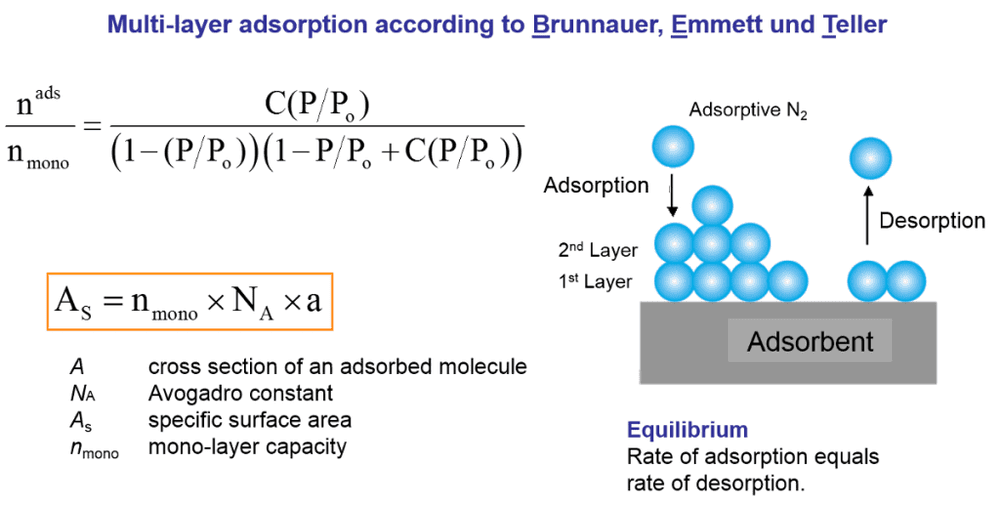
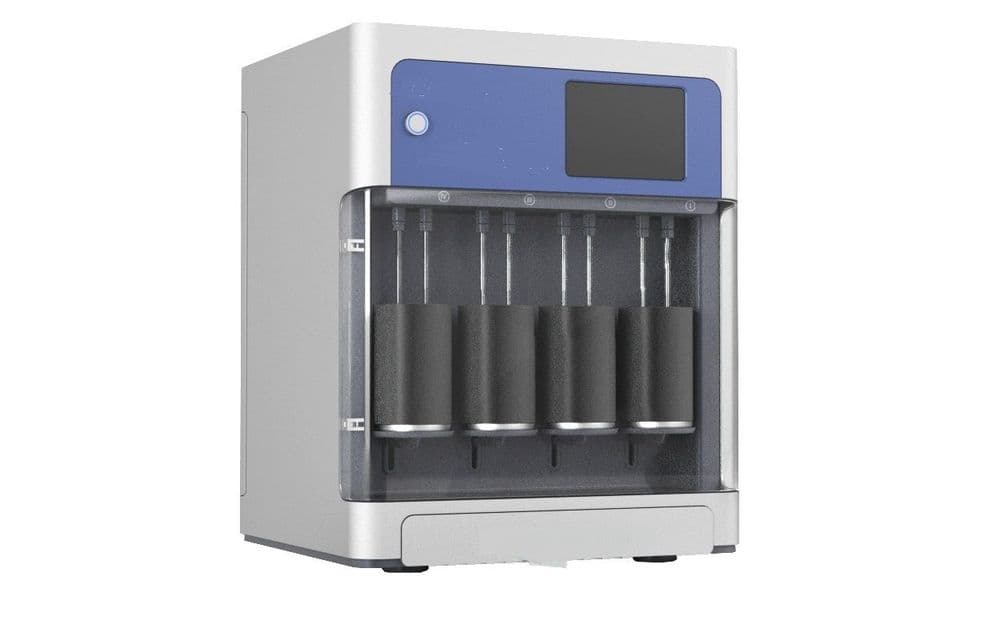

Price may vary based on selected options
Delivery time: 1 ~ 2 weeks
BET (Brunauer–Emmett–Teller) Surface Area Analysis is a widely used method for evaluating the surface properties of materials. It is primarily applied to the analysis of specific surface area and pore structure in porous materials.
By utilizing the adsorption characteristics of solid materials and employing gas molecules as “measuring probes,” the BET method enables precise characterization of surface and porosity-related features. The test provides key parameters such as: Specific surface area, Total pore volume, Pore size distribution, Adsorption/desorption isotherms.
BET (Brunauer–Emmett–Teller) analysis is a powerful tool for characterizing the surface and porosity of solid materials. It provides key information such as:
Specific Surface Area — Measures the total surface area per unit mass (m²/g)
Total Pore Volume — Estimates the overall volume of pores in the material
Average Pore Diameter — Calculates the mean pore size based on surface area and pore volume
Adsorption/Desorption Isotherms — Used to assess pore type and adsorption behavior
Initial Porosity Screening — Helps determine if the material is micro-, meso-, or macroporous
BET is often the first step in porous material analysis, offering quick and reliable insights before more advanced pore size distribution methods (like BJH or DFT) are applied. It plays a critical role in understanding the surface properties of powders, porous structures, and functional materials in both research and industrial applications.
BET surface area analysis is a highly versatile technique used across a wide range of material types and industries. It is particularly effective for characterizing powders, porous materials, and nanomaterials with medium to high surface area. The method is applicable to both organic and inorganic solids, including:
By combining BET with complementary techniques such as BJH, Langmuir, or microscopic imaging (SEM/TEM), users can obtain a more comprehensive understanding of pore structure and surface behavior. For example, MOF materials benefit from BET + Langmuir to resolve micropore contributions, while carbon-based adsorbents are often analyzed using BET + BJH to assess mesopores. Combining BET data with SEM images supports deeper material insight and application design.
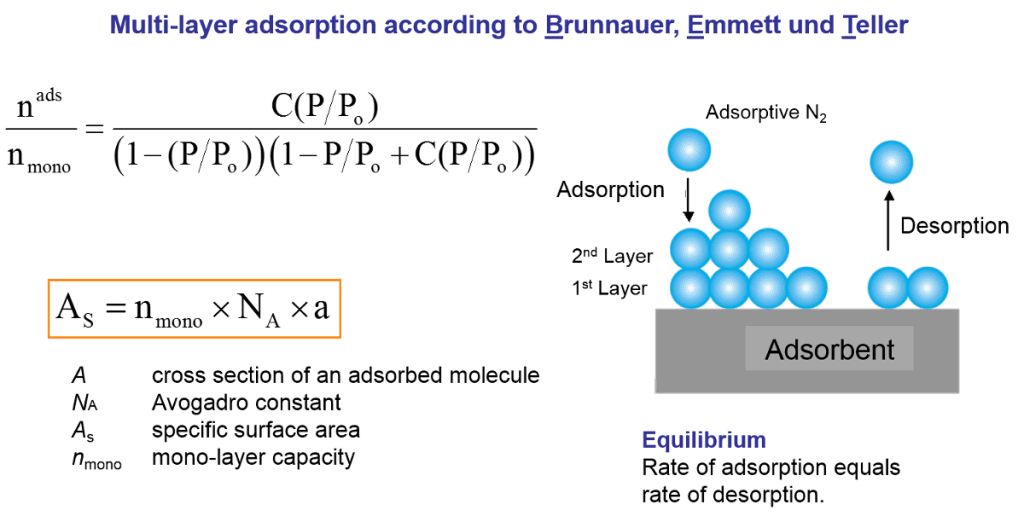
The BET (Brunauer–Emmett–Teller) theory describes the physical adsorption of gas molecules on a solid surface through multilayer formation. It extends the Langmuir model by assuming that after the first monolayer is adsorbed, additional layers can form on top. The BET equation relates the amount of gas adsorbed at various relative pressures to calculate the monolayer capacity, based on assumptions of uniform surface energy and no lateral interactions between adsorbed molecules.
1 Caption: Mathematical principles for calculation of BET surface area
The BET analysis process includes the following key steps:
This process is performed using fully automated, high-precision gas adsorption instruments to ensure accuracy and repeatability.
To ensure accurate results, please follow these sample preparation guidelines:
Contact our team for assistance with any special material conditions.
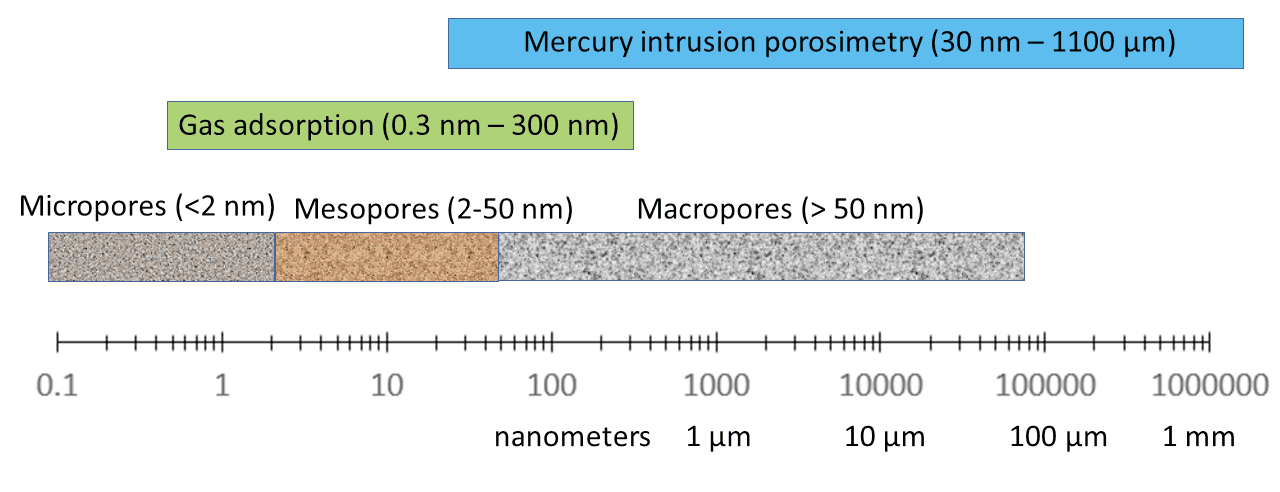
Comparison of Porosity Analysis Methods (Method as Columns)
| Attribute | BET Analysis | BJH Method | Langmuir Model | Mercury Porosimetry | Permeability Methods |
|---|---|---|---|---|---|
| Working Principle | Multilayer gas adsorption using nitrogen | Desorption-based pore size calculation via Kelvin equation | Monolayer adsorption theory on microporous surfaces | Mercury forced into pores under high pressure | Measures gas/liquid flow through sample |
| Pore Size Range | 0.5 – 100 nm (effective: 1–50 nm) | 2 – 50 nm | < 2 nm | 3 nm – 500 µm (most accurate > 50 nm) | > 100 nm (bulk level only) |
| Strengths | High accuracy in surface area; standardized method | Provides mesopore size and volume distribution | Accurate for micropores with strong adsorption | Measures large pores and total pore volume | Fast, non-adsorptive, good for overall porosity |
| Limitations | Cannot determine pore size distribution; poor for micropores | Inaccurate for micropores; prone to artifacts | Ideal surface assumption; sensitive to pressure points | Destructive method; mercury toxicity; poor micropore resolution | Low resolution; affected by tortuosity and structure |
| Recommended Materials | Catalysts, nanopowders, porous oxides | Mesoporous silica, activated carbon | Zeolites, MOFs, activated carbon | Concrete, ceramics, foams, filters | Membranes, filters, construction materials |
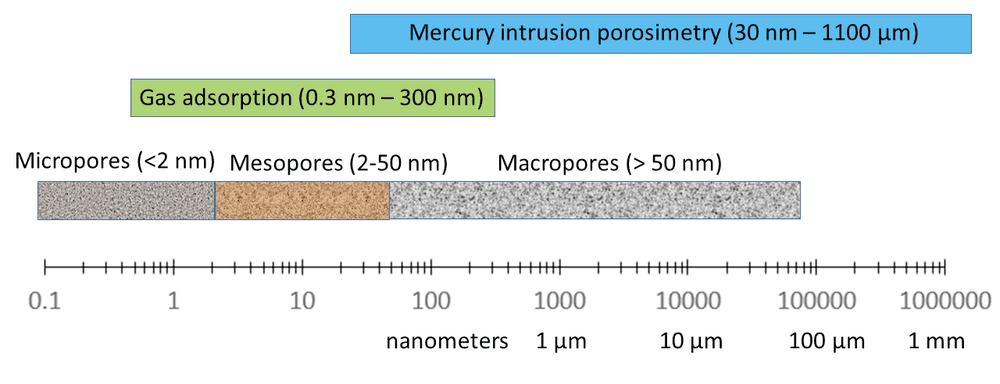
2 Caption: Overview of Suitable Analytical Methods for Various Pore Size Ranges
Advantages:
Limitations:
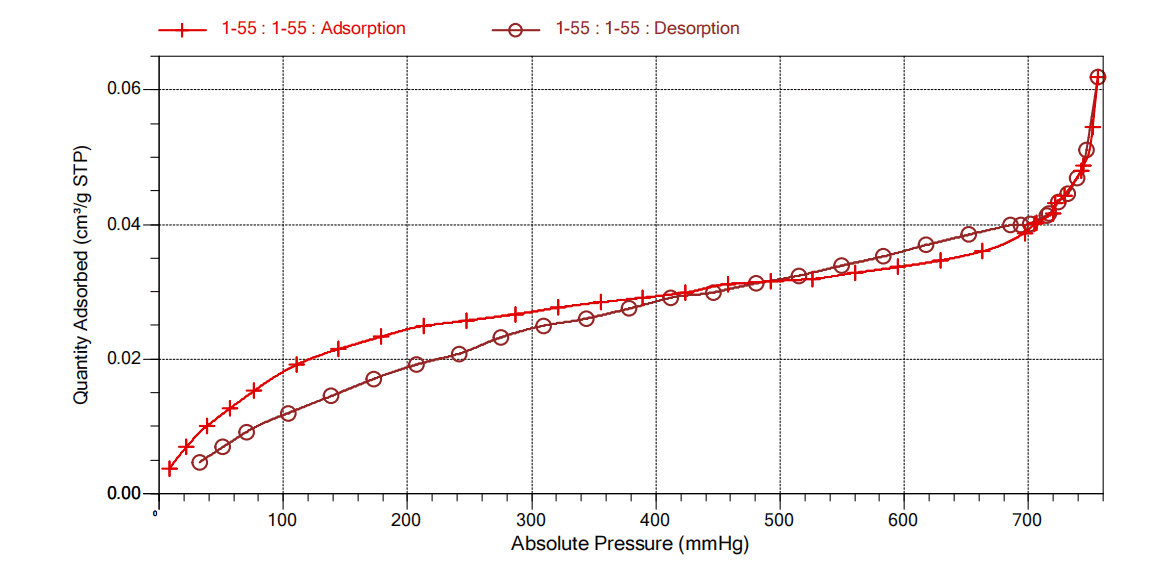
| Parameter | Value (m²/g) |
|---|---|
| Single point surface area at P/Po = 0.220294209 | 30.4405 |
| BET Surface Area | 31.3770 |
| Langmuir Surface Area | 205.6132 |
| t-Plot external surface area | 31.6115 |
3 Caption: BET-Isotherm Linear Absolute Plot
1. Why is the BET surface area value negative?
A: Under normal circumstances, if the sample adsorbs gas molecules, the BET surface area should be positive. A negative value may be caused by several reasons:
2. Why is the adsorption-desorption isotherm not closed?
A: This is a common phenomenon and may occur for several reasons:
3. Why does the BJH desorption pore size distribution show a “false peak”?
A: During gas desorption, hysteresis often occurs. This can create an artificial peak in the BJH pore size distribution, commonly around 3.8 nm. The false peak is usually related to: pore connectivity, complex pore geometries, and wide pore size distributions—all of which affect the desorption pathway.
4. Why is the C value in the BET equation negative?
A: The C value reflects the sample's adsorption heat and should normally be positive. If it is negative:
5. Why do the adsorption and desorption curves cross each other?
A: This crossover may result from:
6. Why doesn’t the pore size distribution start from zero?
A:
7. Why do BET results differ from SEM or TEM observations?
A: SEM/TEM images show local features of a small region, while BET measures the overall pore structure of the bulk material. Discrepancies may arise because:
BET surface area analysis is an essential technique for understanding and optimizing the surface and pore properties of materials. It supports decision-making in material design, quality assurance, and product development across multiple industries.
Contact us today to discuss your analysis needs or to submit your samples for testing.
1. Why is the BET surface area value negative?
A: Under normal circumstances, if the sample adsorbs gas molecules, the BET surface area should be positive. A negative value may be caused by several reasons:
2. Why is the adsorption-desorption isotherm not closed?
A: This is a common phenomenon and may occur for several reasons:
3. Why does the BJH desorption pore size distribution show a “false peak”?
A: During gas desorption, hysteresis often occurs. This can create an artificial peak in the BJH pore size distribution, commonly around 3.8 nm. The false peak is usually related to: pore connectivity, complex pore geometries, and wide pore size distributions—all of which affect the desorption pathway.
4. Why is the C value in the BET equation negative?
A: The C value reflects the sample's adsorption heat and should normally be positive. If it is negative:
5. Why do the adsorption and desorption curves cross each other?
A: This crossover may result from:
6. Why doesn’t the pore size distribution start from zero?
A:
7. Why do BET results differ from SEM or TEM observations?
A: SEM/TEM images show local features of a small region, while BET measures the overall pore structure of the bulk material. Discrepancies may arise because:
BET surface area analysis is a highly versatile technique used across a wide range of material types and industries. It is particularly effective for characterizing powders, porous materials, and nanomaterials with medium to high surface area. The method is applicable to both organic and inorganic solids, including:
| Parameter | Value (m²/g) |
|---|---|
| Single point surface area at P/Po = 0.220294209 | 30.4405 |
| BET Surface Area | 31.3770 |
| Langmuir Surface Area | 205.6132 |
| t-Plot external surface area | 31.6115 |
To ensure reliable results, please follow these/mple guidelines:
Feel free to contact our team for questions regarding specific materials or sample preparation requirements. If your sample exceeds standard requirements, please contact us for a customized solution.