
info@universallab.org
WhatsApp: +41762172997

logo-header
​
logo
Material Testing
Mechanical Testing
Tensile TestFibre Tensile TestHardness TestImpact TestFatigue TestOthers
Thermal Testing
Thermomechanical AnalysisDSCTGATGA (TG-DSC, TG-DTA)
Surface, Coating and Corrosion
Adhesion TestScratch TestCorrosion Cycle Test
Physical Properties
Functional propertiesPorosityDensity
Elemental & Chemical Composition
Compositional analysisElemental analysis
Microscopic Characterization
Particle analysisMicroscopy
Product Testing
Food & Agriculture Testing
Consumer Goods Testing
Electronics & Electrical Testing
Medical & Pharmaceutical Testing
Automotive & Transportation Testing
Packaging & Materials Testing
Chemical & Hazardous Substances Testing
Semiconductor Testing
Battery Testing
Petrochemical Testing
Environmental Test
Water Testing
Drinking Water Analysis
Soil & Sediment Testing
Soil Chemistry (pH, Nutrients)
Air Testing
Particulate Matter (PM2.5, PM10)
Noise & Acoustic Testing
Industrial/Occupational Noise
Waste & Sludge Testing
Hazardous Waste Classification
Instrumental Test
Spectroscopy
Emission
XRFXPSICP-OESGD-OES
Absorption
FTIRUV/VIS/NIRAAS
Mass Spectrometry
SIMSICP-MS
Other
RamanNMR
Microscopy
Electron
SEMTEMEBSDEMPA
Other
AFMFIB
Mechanical
Volumetric
Tensile TestFibre Tensile TestImpact TestFatigue Test
Surface
HardnessNanoindentationScratch
Others
Thermal Analysis
TGADSC
Physical Analysis
BETLaser diffractionDensityContact AngleZeta potential
Chromatography
GCHPLCIC
Services
  • Applications
  • Techniques
  • Standards
  • Industries
Regulatory testing
  • PFAS
  • REACH
  • VOC
Environmental testing
  • Water
  • Gas
Data analysis
  • XRD
  • XPS
  • FTIR
  • Raman
  • NMR
  • CT
  • SIMS
  • TGA
Blog
  • Knowledge
  • News
  • Policy
  • About us
    Contact

    Sample Requirements

    Application Case

    Example Result

    What our customers are saying

    Need precise analysis? Contact us – we'll help you choose the best solution for your needs.

    info@universallab.org+41 762172997
    Lab technician holding a blue flask

    Frequently Asked Questions

    HomeCategoryCart
    logo-footer-shop1

    European material analytical and measuring service provider dedicated for academic and industrial research

    About Us
    CareersTerms & ConditionsPrivacy Policy
    Customer Services
    Help CenterBecome a partnerReturns & Refunds
    Contact Us

    Parkstrasse 1, 5234 Villigen, Switzerland

    Email: info@universallab.org

    Phone: +41 762172997

    VAT: CHE-265.266.739 MWST

    © 2026 By Universallab. All rights reserved.

    This site is protected by reCAPTCHA and the Google Privacy Policy and Terms of Service apply.
    product
    product-0

    Fatigue Testing

    Variant (SKU)
    RT
    RT~650 °C or cryogenic to -65 °C
    651~800 °C
    801~900 °C
    901~1000 °C
    above 1000 °C
    –196 ~1170 °C
    Load Spectrum Fatigue
    Tension-Torsion / Torsion-Torsion

    Price may vary based on selected options

    Delivery time: 1 ~ 2 weeks

    Introduction

    Introduction

    Introduction

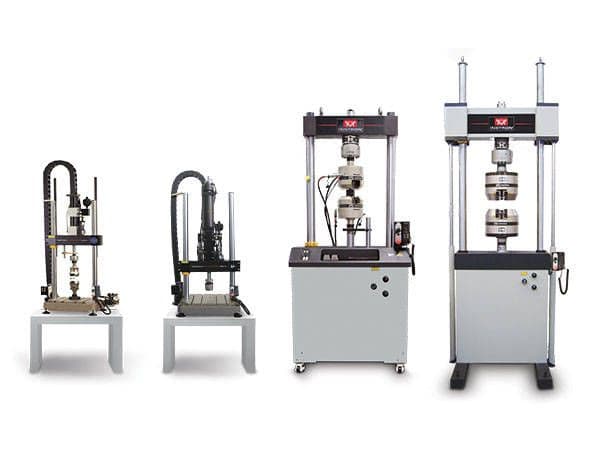
    The fatigue testing machine is used to determine the fatigue characteristics, fatigue life, prefabricated cracks, and crack propagation of metals, alloys, and their components (such as operating joints, fasteners, helical motion parts, etc.) under tensile, compression, or tensile-compressive alternating loads at room temperature. Fatigue testing machines are generally classified into the following categories:

    • By Loading Method: Tension-compression fatigue, bending fatigue, torsional fatigue, etc.

    • By Stress Ratio: Symmetric fatigue, asymmetric fatigue.

    • By Testing Environment: Room temperature fatigue, low-temperature fatigue, high-temperature fatigue, corrosive fatigue, etc.

    • By Stress Cycle Number at Fracture: Low-cycle fatigue, high-cycle fatigue.

    • By Frequency: Low-frequency fatigue, medium-frequency fatigue, high-frequency fatigue, ultra-high-frequency fatigue.

    Principle

    Principle

    Principle

    A fatigue testing machine is a device used to evaluate the fatigue performance of materials or components under cyclic loading. Its basic working principle is to apply periodic alternating loads to simulate the long-term stress conditions experienced by the product in real-world applications until the specimen undergoes fatigue failure (such as crack initiation, propagation, or fracture).

    Fatigue testing involves applying repeated cyclic loads to a material or component to simulate the long-term stress conditions it would experience in real-world applications. The goal is to assess potential fatigue failure over time. For products, fatigue testing helps ensure safety and reliability during actual use, especially for components subjected to frequent stress cycles, such as automotive parts and aerospace components.

    Fatigue testing is typically conducted in accordance with international and industry standards. Common standards include:

    • ISO 12107: Fatigue testing of metallic materials
    • ASTM E466: Rotating bending fatigue testing of metals
    • ISO 7149: Fatigue testing of plastics

    The duration of a fatigue test depends on several factors, including the material type, loading conditions, frequency, expected number of cycles, and equipment capability. Some simple tests may be completed in a few days, while more complex tests may take several weeks or even months. The exact time depends on your specific requirements and test parameters.

    Applicable industries

    Applicable industries

    Applicable Material Types

    • Metal Materials: Such as steel, aluminum, titanium, copper, and nickel-based alloys.
    • Alloys: Such as high-temperature alloys, stainless steel, aluminum alloys, etc.
    • Composite Materials: Such as carbon fiber composites, glass fiber composites.
    • Polymers / Plastics: Thermoplastics, thermosets, elastomers.
    • Ceramics: Alumina, silicon nitride, zirconia.
    • Concrete and Cement-Based Materials: Reinforced concrete, pre-stressed concrete.
    • Natural Materials: Wood, bamboo, bone.
    • Rocks and Geomaterials: Limestone, granite, sandstone.
    Industrial Application

    Industrial Application

    Industrial Application

    • Aerospace: In the testing of aircraft, spacecraft, and high-end equipment components such as engines, wings, and structural parts. Fatigue testing ensures the safety of these parts under extreme operational conditions.
    • Automotive Industry: Used to test automotive components such as engine parts, suspension systems, and wheels for fatigue life, ensuring vehicle reliability after long-term use.
    • Energy and Power: In wind power, nuclear power, and traditional power generation, fatigue testing machines are used to assess the fatigue resistance of components like turbine blades, generators, and pipelines, ensuring their stability during prolonged operation.
    • Construction and Structural Engineering: Used to test building materials, bridges, tunnels, railway tracks, etc., ensuring the safety and durability of these infrastructures over time.
    • Military and Defense: In military equipment, weapons systems, and fighter jets, fatigue testing helps assess the fatigue properties of materials and components, improving combat reliability.
    • : Used to test the fatigue life of medical devices such as implants, prosthetics, and surgical instruments, ensuring their stability and safety during prolonged use.

    1. Caption: Example of Fatigue Testing results.

    stress range (MPa)cycle number (N)
    80500,000
    100300,000
    120150,000
    14031,6115
    Technical Parameters

    Technical Parameters

    • Sample amount: Typically sized to fit the grips and testing area of the fatigue testing machine, usually ranging from 50 mm to 300 mm in length, depending on the material type and test method.
    • State: The sample should be in its standard operational state (e.g., as-cast, heat-treated, or as-manufactured) to ensure that test conditions reflect real-world usage.
    • Surface condition: The sample should have a smooth, defect-free surface, without visible cracks or imperfections. Any surface treatments (e.g., polishing, sanding) should be consistent with the testing requirements.
    • Packaging: The sample should be stored in a manner that prevents damage or contamination. Use appropriate protective packaging to avoid scratches or dents during transport.
    • Geometry: Ensure the sample geometry matches the testing method (tensile, compression, bending, or torsion fatigue). Dimensions and shapes should conform to industry standards or be customized based on the fatigue test type.
    Medical Devices

    The fatigue testing machine is a device used to simulate and test the fatigue performance of materials under repeated loading conditions, assessing the material's durability and lifespan by applying cyclic stress or strain. It is widely used in fields such as aerospace, automotive, and mechanical engineering to verify the reliability and safety of materials and components in real-world applications.