info@universallab.org
WhatsApp: +41762172997

logo-header
​
logo
Material Testing
Mechanical Testing
Tensile TestFibre Tensile TestHardness TestImpact TestFatigue TestOthers
Thermal Testing
Thermomechanical AnalysisDSCTGATGA (TG-DSC, TG-DTA)
Surface, Coating and Corrosion
Adhesion TestScratch TestCorrosion Cycle Test
Physical Properties
Functional propertiesPorosityDensity
Elemental & Chemical Composition
Compositional analysisElemental analysis
Microscopic Characterization
Particle analysisMicroscopy
Product Testing
Food & Agriculture Testing
Consumer Goods Testing
Electronics & Electrical Testing
Medical & Pharmaceutical Testing
Automotive & Transportation Testing
Packaging & Materials Testing
Chemical & Hazardous Substances Testing
Semiconductor Testing
Battery Testing
Petrochemical Testing
Environmental Test
Water Testing
Drinking Water Analysis
Soil & Sediment Testing
Soil Chemistry (pH, Nutrients)
Air Testing
Particulate Matter (PM2.5, PM10)
Noise & Acoustic Testing
Industrial/Occupational Noise
Waste & Sludge Testing
Hazardous Waste Classification
Instrumental Test
Spectroscopy
Emission
XRFXPSICP-OESGD-OES
Absorption
FTIRUV/VIS/NIRAAS
Mass Spectrometry
SIMSICP-MS
Other
RamanNMR
Microscopy
Electron
SEMTEMEBSDEMPA
Other
AFMFIB
Mechanical
Volumetric
Tensile TestFibre Tensile TestImpact TestFatigue Test
Surface
HardnessNanoindentationScratch
Others
Thermal Analysis
TGADSC
Physical Analysis
BETLaser diffractionDensityContact AngleZeta potential
Chromatography
GCHPLCIC
Services
  • Applications
  • Techniques
  • Standards
  • Industries
Regulatory testing
  • PFAS
  • REACH
  • VOC
Environmental testing
  • Water
  • Gas
Data analysis
  • XRD
  • XPS
  • FTIR
  • Raman
  • NMR
  • CT
  • SIMS
  • TGA
Blog
  • Knowledge
  • News
  • Policy
  • About us
    Contact

    Sample Requirements

    Application Case

    Example Result

    What our customers are saying

    Need precise analysis? Contact us – we'll help you choose the best solution for your needs.

    info@universallab.org+41 762172997
    Lab technician holding a blue flask

    Frequently Asked Questions

    HomeCategoryCart
    logo-footer-shop1

    European material analytical and measuring service provider dedicated for academic and industrial research

    About Us
    CareersTerms & ConditionsPrivacy Policy
    Customer Services
    Help CenterBecome a partnerReturns & Refunds
    Contact Us

    Parkstrasse 1, 5234 Villigen, Switzerland

    Email: info@universallab.org

    Phone: +41 762172997

    VAT: CHE-265.266.739 MWST

    © 2026 By Universallab. All rights reserved.

    This site is protected by reCAPTCHA and the Google Privacy Policy and Terms of Service apply.
    product
    product-0

    Inductively Coupled Plasma – Mass Spectrometry (ICP-MS)

    Variant (SKU)
    Single element quantification
    All element, Semi-quantitative

    Price may vary based on selected options

    Delivery time: 1 ~ 2 weeks

    Introduction

    Introduction

    Introduction

    ICP-MS (Inductively Coupled Plasma Mass Spectrometry) is an ultra-sensitive technique for trace and ultra-trace elemental analysis. It combines a high-temperature plasma ion source with a mass spectrometer for precise ion detection. Key Features:

    • Ultra-low detection limits: Down to parts-per-trillion (ppt) or lower
    • Multi-element analysis: Detects multiple elements in a single run
    • Isotopic capability: Enables both quantification and isotope ratio analysis
    • Wide dynamic range: From ppt levels up to percentage concentrations
      ICP-MS is widely used in fields requiring the highest analytical sensitivity, including environmental monitoring, pharmaceuticals, food safety, nuclear science, and semiconductor manufacturing.
    Principle

    Principle

    Principle

    The ICP-MS process involves ion generation, mass separation, and ion detection:

    1. Liquid samples are nebulized into a fine aerosol
    2. The aerosol is introduced into a high-temperature argon plasma (~8000 K), where it is atomized and ionized
    3. The ions pass through a sampling cone into the mass spectrometer
    4. Ions are separated based on their mass-to-charge ratio (m/z) and detected
    Test Procedure

    Test Procedure

    Test Procedure

    ICP-MS testing follows these steps:

    1. Sample preparation: Digestion, dilution, or filtration

    ICP-MS has lower detection limits (ppt vs. ppb) and can perform isotopic analysis. ICP-OES is more tolerant of high-concentration samples.

    Yes, it’s widely used in nuclear, geological, and forensic studies.

    They occur when ions of similar m/z overlap (e.g., ArCl⁺ with As⁺). Collision/reaction cells or software corrections are used to resolve them.

    Internal standards, certified reference materials, matrix-matched calibration, and quality controls are used.

    Yes, but solids must first be digested into a clear liquid form.

    Applicable industries

    Applicable industries

    ICP-MS is suitable for trace analysis of metals and some non-metals in liquid samples. Its ultra-low detection limits make it ideal for high-purity and regulatory samples.

    Typical Sample Types:

    • Environmental samples: Surface water, groundwater, rainwater, soil digests
    • Industrial samples: High-purity metals, plating baths, process solutions
    • Food & agriculture: Additives, nutrients, contaminants
    • Pharmaceuticals: Elemental impurities (ICH Q3D compliance)
    • Semiconductors: Ultra-pure water (UPW), wafers, etching liquids
    • Biomedical: Blood, urine, tissue digests
    Applicable materials type

    Applicable materials type

    Common Application Areas:

    • Environmental testing: Trace metal compliance analysis
    • Food and beverages: Heavy metals such as As, Pb, Cd, Hg
    • Pharmaceuticals & life sciences: Trace contaminants, isotope tracing
    • Semiconductor industry: Contamination control at sub-ppb levels
    • Nuclear and isotope research: Isotope ratio determination (e.g., U-235/U-238)
    • Geochemistry & mining: Rare earth elements, precious metals

    Example results

    ElementConcentration (ug/L)Detection Limit (ug/L)
    As0.0340.0005
    Cd0.0110.0002
    Pb0.0720.0008
    U0.0040.0001
    Hg0.0010.0005

    Sample Preparation and Important Notes

    ICP-OES / ICP-MS analysis requires careful sample handling to ensure reliable results and protect instrument integrity. Please read the following sample submission guidelines before testing.


    1. General Recommendations

    • Elements such as Br and I are best analyzed using ICP-MS, which provides more accurate results compared to other techniques.
    • For samples containing elements with widely different concentrations, it is recommended to prepare separate solutions:
      • Use ICP-OES for elements in the ppm range
      • Use ICP-MS for elements in the ppb range
        Alternatively, send the original solution, and the laboratory will perform separate dilutions as needed. Orders can be grouped by concentration levels.

    ⚠️ Note: Elements such as Ru, Rh, As, Ag, U, P, S, Si may be difficult to digest or may generate weak signals. Quantitative accuracy cannot be guaranteed. However, ICP still offers relatively accurate estimates compared to other methods. Please evaluate the associated risks before proceeding with analysis.


    2. Requirements for Pre-treated Liquid Samples

    • a. Clarity and stability: Provide a transparent, clear, and stable solution without visible precipitates.

      • For colored solutions, confirm whether it is a true ionic solution. If uncertain, re-digest with acid to prevent damage to the instrument.
      • Submit 5–10 mL of solution. Samples should be slightly acidic to neutral, with total acid concentration below 5%.
      • HF-digested samples must not be tested directly. Fluoride ions must be removed (e.g., by evaporation), and digested solutions should still be diluted.
    • b. Organic solvents or carbon-containing liquids must not be submitted directly. Digest with nitric acid until carbon is completely removed.

    • c. Particulate-free: Solutions must be free of any undissolved solids or organic residues.

      • Pass samples through a 0.45 μm membrane filter.
      • Ensure containers are sealed tightly and wrapped in parafilm to prevent leakage.

    3. Requirements for Untreated Liquid Samples

    • a. Standard water samples (e.g., those requiring GB compliance) should be .
  • Calibration: External or internal standards
  • Nebulization: Sample converted into aerosol
  • Ionization and separation: Ions generated in the plasma, sorted by mass
  • Detection and quantification: Ion signals converted into concentrations
  • Collision/Reaction Cell (CRC) technology is often used to minimize spectral interferences.


    Pros and Cons

    Comparison of Analytical Techniques:

    AttributeICP-OESAAS (Flame/Furnace)ICP-MSXRFWet Chemistry (Titration)
    Working PrincipleOptical emission from excited atoms in plasmaLight absorption by ground-state atomsMass detection of ions in plasmaX-ray induced fluorescenceStoichiometric chemical reactions
    Elements Detected≥70 (metals and non-metals)Limited (~30)≥75~40Limited
    Detection Limitssub-ppb to ppmppm to ppb (graphite furnace)ppt to ppbppmVariable
    Sample ThroughputHigh (multi-element)Low (single element)HighModerateLow
    Matrix ToleranceGood (some interference correction available)ModerateHigh (collision/reaction cell options)VariableLow
    Recommended UseRoutine trace analysis in complex matricesLow-cost single-element analysisUltra-trace and speciation studiesSolid sample screeningClassical wet-lab environments

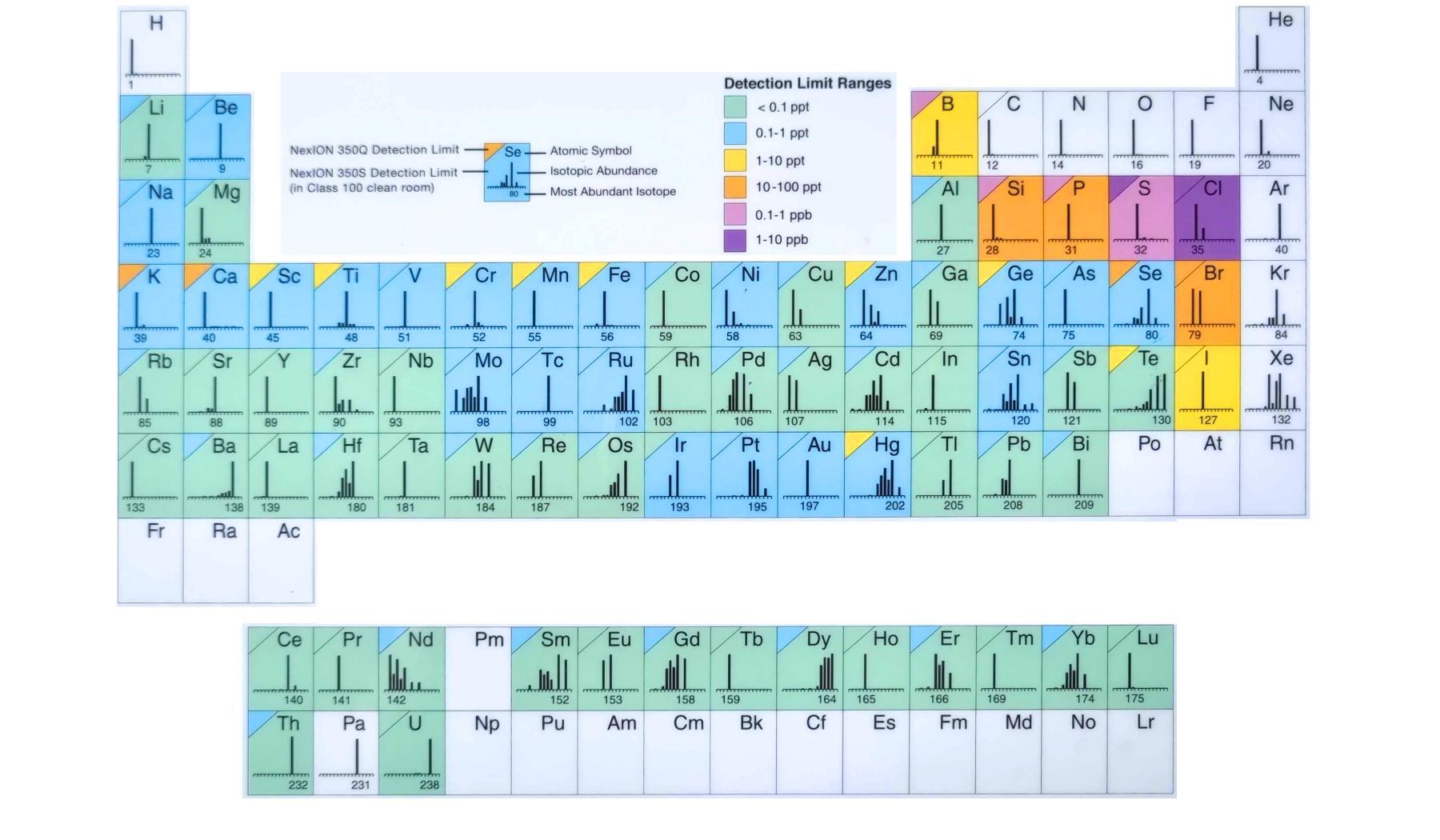
    2 Caption: List of elements that can be tested by ICP-OES

    ICPMS elementDetection range.jpg

    Advantages:

    • Extremely low detection limits
    • Isotopic analysis capabilities
    • Fast multi-element analysis
    • Minimal sample volume required
    • High automation and precision

    Limitations:

    • Higher instrument and maintenance cost
    • Requires cleanroom-like handling
    • Spectral interferences need correction
    • Operation requires skilled personnel

    ≥ 50 mL
  • b. Other or self-formulated liquid samples should be ≥ 10 mL. Clearly indicate sample composition to aid digestion protocol selection.
  • c. Seal sample bottles and wrap them with parafilm.

  • 4. Requirements for Untreated Solid Samples

    • a. Powder samples: Provide at least 100 mg, finely ground. If possible, sieve through 200 mesh.

      • For microwave digestion, at least 200 mg is required.
    • b. Trace amounts of solid samples should be wrapped in weighing paper and placed in a secure labeled tube.


    5. Recovery Policy

    ICP analysis is a destructive method. Material introduced into the instrument cannot be returned. Only unused portions of the sample (if available) can be recovered.


    6. Special Situations

    For limited sample quantities or special element testing, please consult your local project manager or contact our technical support team before submission.

    ICP-MS (Inductively Coupled Plasma Mass Spectrometry) is an ultra-sensitive technique for trace and ultra-trace elemental analysis. It combines a high-temperature plasma ion source with a mass spectrometer for precise ion detection.

    Key Features:

    • Ultra-low detection limits: Down to parts-per-trillion (ppt) or lower
    • Multi-element analysis: Detects multiple elements in a single run
    • Isotopic capability: Enables both quantification and isotope ratio analysis
    • Wide dynamic range: From ppt levels up to percentage concentrations

    ICP-MS is widely used in fields requiring the highest analytical sensitivity, including environmental monitoring, pharmaceuticals, food safety, nuclear science, and semiconductor manufacturing.