
info@universallab.org
WhatsApp: +41762172997

logo-header
​
logo
Material Testing
Mechanical Testing
Tensile TestFibre Tensile TestHardness TestImpact TestFatigue TestOthers
Thermal Testing
Thermomechanical AnalysisDSCTGATGA (TG-DSC, TG-DTA)
Surface, Coating and Corrosion
Adhesion TestScratch TestCorrosion Cycle Test
Physical Properties
Functional propertiesPorosityDensity
Elemental & Chemical Composition
Compositional analysisElemental analysis
Microscopic Characterization
Particle analysisMicroscopy
Product Testing
Food & Agriculture Testing
Consumer Goods Testing
Electronics & Electrical Testing
Medical & Pharmaceutical Testing
Automotive & Transportation Testing
Packaging & Materials Testing
Chemical & Hazardous Substances Testing
Semiconductor Testing
Battery Testing
Petrochemical Testing
Environmental Test
Water Testing
Drinking Water Analysis
Soil & Sediment Testing
Soil Chemistry (pH, Nutrients)
Air Testing
Particulate Matter (PM2.5, PM10)
Noise & Acoustic Testing
Industrial/Occupational Noise
Waste & Sludge Testing
Hazardous Waste Classification
Instrumental Test
Spectroscopy
Emission
XRFXPSICP-OESGD-OES
Absorption
FTIRUV/VIS/NIRAAS
Mass Spectrometry
SIMSICP-MS
Other
RamanNMR
Microscopy
Electron
SEMTEMEBSDEMPA
Other
AFMFIB
Mechanical
Volumetric
Tensile TestFibre Tensile TestImpact TestFatigue Test
Surface
HardnessNanoindentationScratch
Others
Thermal Analysis
TGADSC
Physical Analysis
BETLaser diffractionDensityContact AngleZeta potential
Chromatography
GCHPLCIC
Services
  • Applications
  • Techniques
  • Standards
  • Industries
Regulatory testing
  • PFAS
  • REACH
  • VOC
Environmental testing
  • Water
  • Gas
Data analysis
  • XRD
  • XPS
  • FTIR
  • Raman
  • NMR
  • CT
  • SIMS
  • TGA
Blog
  • Knowledge
  • News
  • Policy
  • About us
    Contact

    Sample Requirements

    Application Case

    Example Result

    What our customers are saying

    Need precise analysis? Contact us – we'll help you choose the best solution for your needs.

    info@universallab.org+41 762172997
    Lab technician holding a blue flask

    Frequently Asked Questions

    HomeCategoryCart
    logo-footer-shop1

    European material analytical and measuring service provider dedicated for academic and industrial research

    About Us
    CareersTerms & ConditionsPrivacy Policy
    Customer Services
    Help CenterBecome a partnerReturns & Refunds
    Contact Us

    Parkstrasse 1, 5234 Villigen, Switzerland

    Email: info@universallab.org

    Phone: +41 762172997

    VAT: CHE-265.266.739 MWST

    © 2026 By Universallab. All rights reserved.

    This site is protected by reCAPTCHA and the Google Privacy Policy and Terms of Service apply.
    product
    product-0

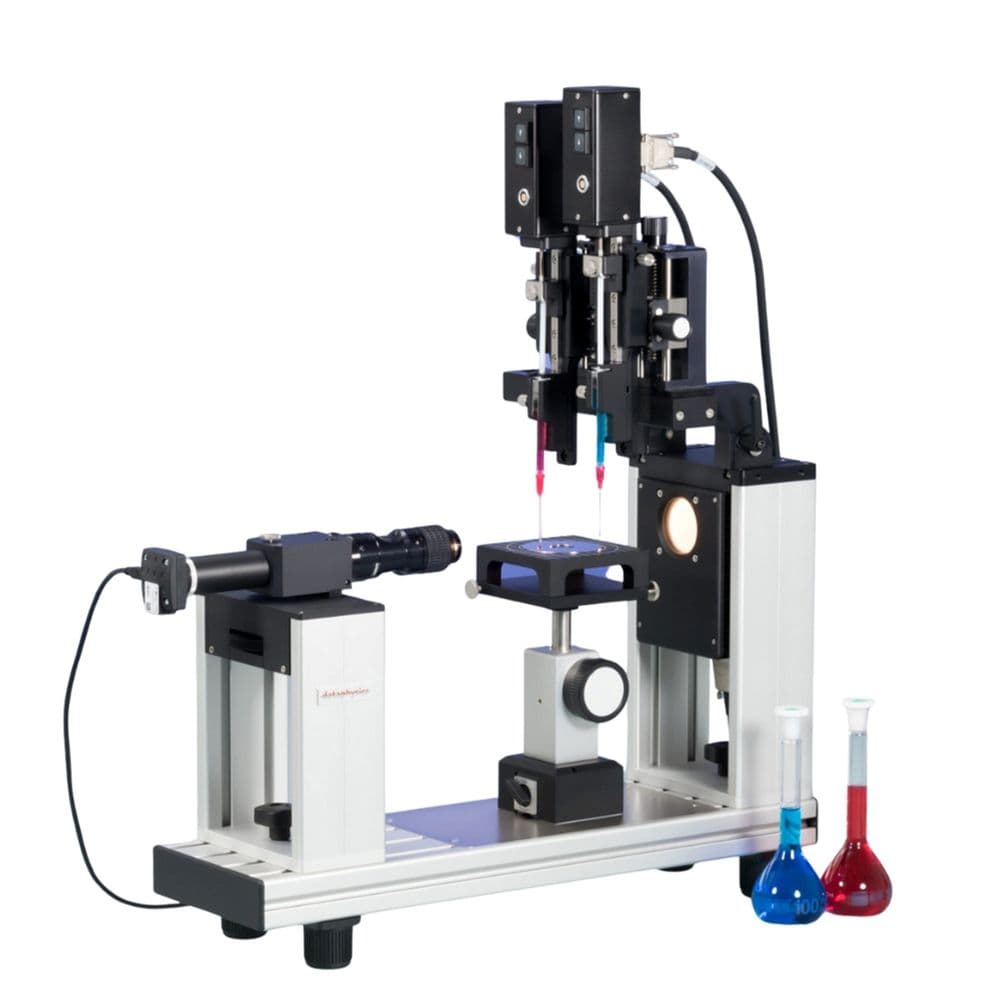
    Contact angle measuring and drop contour analysis system

    Variant (SKU)
    Static contact angle
    Dynamic contact angle
    Fiber direct test
    High temperature

    Price may vary based on selected options

    Delivery time: 1 ~ 2 weeks

    Introduction

    Introduction

    Introduction

    Contact angle measurement and drop contour analysis is a fundamental technique used to characterize the wettability, surface energy, and interfacial interactions of solid surfaces. By analyzing the shape of a liquid droplet placed on a surface, researchers can infer how hydrophilic or hydrophobic the material is, and gain insights into adhesion, coating performance, and surface treatment effects. This method is critical in materials science, surface engineering, biomaterials research, and quality control in coatings, electronics, and consumer products.

    Principle

    Principle

    Principle

    Contact angle and drop contour analysis are based on the optical observation of liquid droplet behavior on solid surfaces.

    1. Sessile Drop Method: A droplet (usually water or test liquid) is deposited on the surface using a micro-syringe.
    2. Image Capture: A high-resolution side-view camera captures the profile of the droplet in real-time.
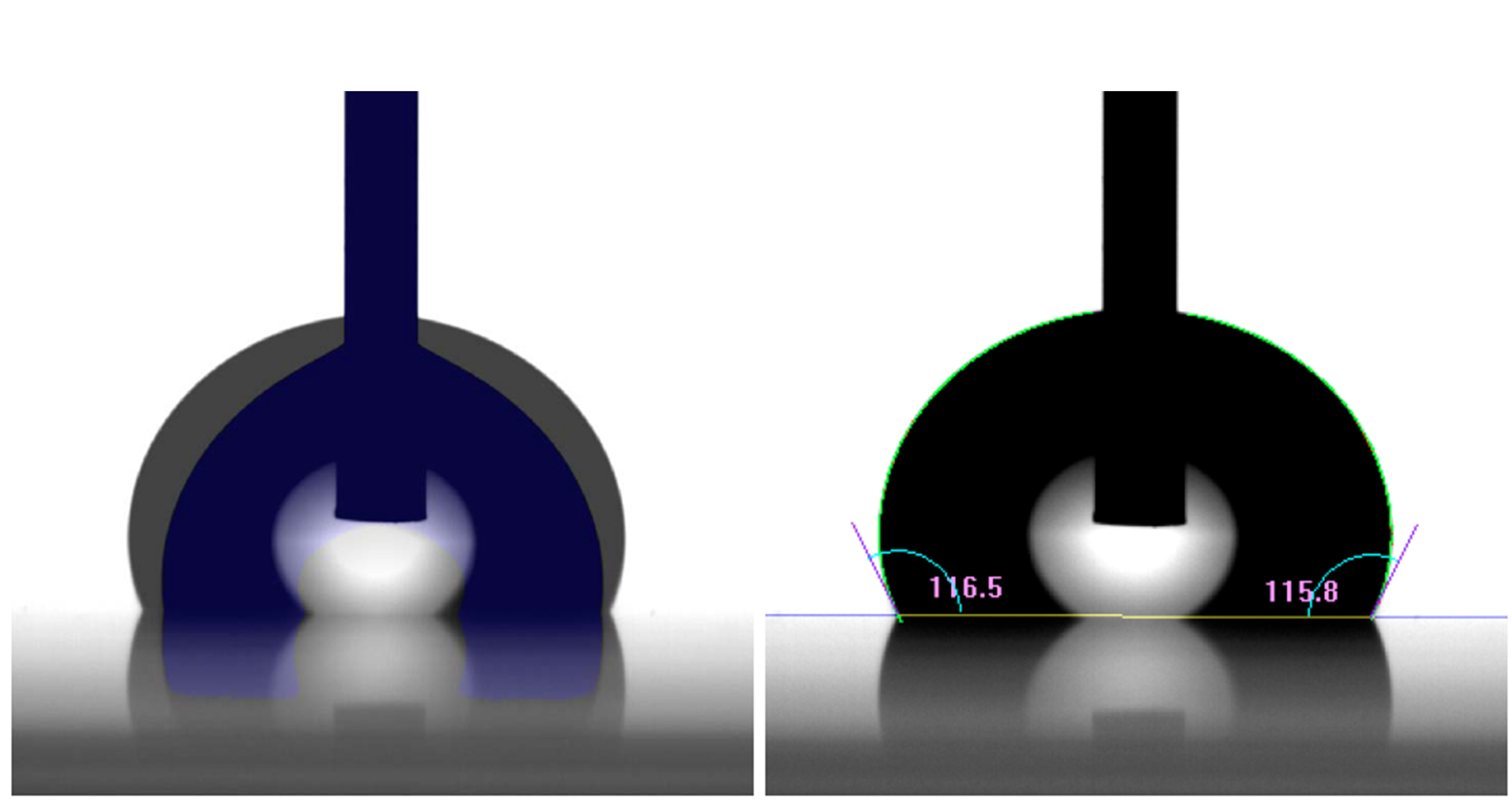
    3. Contour Fitting: The droplet shape is fitted with mathematical models (e.g., Young-Laplace or circle fitting) to calculate the contact angle at the solid-liquid-air interface.
    4. Contact Angle Types:
      • Static Contact Angle: The angle at equilibrium
      • Advancing/Receding Angle: Measured by increasing or decreasing drop volume
      • Dynamic Analysis: Evaluates hysteresis and surface mobility
    5. Surface Free Energy: Can be calculated by measuring contact angles with multiple probe liquids (e.g., water, diiodomethane, ethylene glycol) and applying models like Owens-Wendt or Fowkes theory.

    It depends on application. more than 90° indicates hydrophobicity; less than 90° suggests hydrophilicity. Superhydrophobic surfaces typically show angles >150°.

    Standard systems can measure droplets as small as 0.5–1.0 μL.

    Yes, with special sample holders and image analysis corrections, though accuracy may be affected.

    Yes, upon request. We use multi-liquid methods (Owens-Wendt, Fowkes, or Wu) to calculate polar and dispersive components of surface energy.

    Yes. We offer environmental control chambers for climate-sensitive materials.

    Applicable industries

    Applicable industries

    This analysis technique applies to a broad range of materials and application scenarios:
    • Sample types: metals, polymers, ceramics, glass, treated surfaces, thin films, textiles, paper
    • Common applications:
      • Hydrophobicity/hydrophilicity assessment
      • Surface free energy (SFE) calculation
      • Evaluation of surface treatment (e.g. plasma, silanization, etching)
      • Quality control of coatings, adhesives, and laminates
      • Inkjet printing and microfluidic surface design
    • Industries served: semiconductors, coatings, printing, packaging, biomedical, aerospace, textiles, research labs

    YX-contact angle-result1.jpg

    • Surface area: ≥ 1 × 1 cm recommended
    • Flatness: Surface should be smooth and level; curved samples may need adjustment
    • Cleanliness: No dust, oil, or fingerprints; clean with ethanol or plasma as needed
    • Porous materials: May absorb liquids quickly; measurements must be taken immediately after drop placement
    • Temperature/Humidity: Optional control available for environmental sensitivity studies
    Test Procedure

    Test Procedure

    Test Procedure

    Our standard contact angle and drop shape analysis includes:

    1. Sample preparation: Ensure the surface is flat, clean, and dry. Handle with gloves or tweezers to avoid contamination.
    2. Drop deposition: Dispense 1–3 μL of test liquid (e.g., deionized water) on the surface via automated or manual syringe.
    3. Image acquisition: Use high-speed camera to capture drop shape within milliseconds.
    4. Contour analysis: Fit left and right profiles, measure static or dynamic angles, and compute relevant values.
    5. Reporting: Provide annotated images, angle distributions, and optional surface energy calculations.

    Contact angle measurement and drop contour analysis is a fundamental technique used to characterize the wettability, surface energy, and interfacial interactions of solid surfaces. By analyzing the shape of a liquid droplet placed on a surface, researchers can infer how hydrophilic or hydrophobic the material is, and gain insights into adhesion, coating performance, and surface treatment effects.