info@universallab.org
WhatsApp: +41762172997

logo-header
​
logo
Material Testing
Mechanical Testing
Tensile TestFibre Tensile TestHardness TestImpact TestFatigue TestOthers
Thermal Testing
Thermomechanical AnalysisDSCTGATGA (TG-DSC, TG-DTA)
Surface, Coating and Corrosion
Adhesion TestScratch TestCorrosion Cycle Test
Physical Properties
Functional propertiesPorosityDensity
Elemental & Chemical Composition
Compositional analysisElemental analysis
Microscopic Characterization
Particle analysisMicroscopy
Product Testing
Food & Agriculture Testing
Consumer Goods Testing
Electronics & Electrical Testing
Medical & Pharmaceutical Testing
Automotive & Transportation Testing
Packaging & Materials Testing
Chemical & Hazardous Substances Testing
Semiconductor Testing
Battery Testing
Petrochemical Testing
Environmental Test
Water Testing
Drinking Water Analysis
Soil & Sediment Testing
Soil Chemistry (pH, Nutrients)
Air Testing
Particulate Matter (PM2.5, PM10)
Noise & Acoustic Testing
Industrial/Occupational Noise
Waste & Sludge Testing
Hazardous Waste Classification
Instrumental Test
Spectroscopy
Emission
XRFXPSICP-OESGD-OES
Absorption
FTIRUV/VIS/NIRAAS
Mass Spectrometry
SIMSICP-MS
Other
RamanNMR
Microscopy
Electron
SEMTEMEBSDEMPA
Other
AFMFIB
Mechanical
Volumetric
Tensile TestFibre Tensile TestImpact TestFatigue Test
Surface
HardnessNanoindentationScratch
Others
Thermal Analysis
TGADSC
Physical Analysis
BETLaser diffractionDensityContact AngleZeta potential
Chromatography
GCHPLCIC
Services
  • Applications
  • Techniques
  • Standards
  • Industries
Regulatory testing
  • PFAS
  • REACH
  • VOC
Environmental testing
  • Water
  • Gas
Data analysis
  • XRD
  • XPS
  • FTIR
  • Raman
  • NMR
  • CT
  • SIMS
  • TGA
Blog
  • Knowledge
  • News
  • Policy
  • About us
    Contact

    Sample Requirements

    Application Case

    Example Result

    What our customers are saying

    Need precise analysis? Contact us – we'll help you choose the best solution for your needs.

    info@universallab.org+41 762172997
    Lab technician holding a blue flask

    Frequently Asked Questions

    HomeCategoryCart
    logo-footer-shop1

    European material analytical and measuring service provider dedicated for academic and industrial research

    About Us
    CareersTerms & ConditionsPrivacy Policy
    Customer Services
    Help CenterBecome a partnerReturns & Refunds
    Contact Us

    Parkstrasse 1, 5234 Villigen, Switzerland

    Email: info@universallab.org

    Phone: +41 762172997

    VAT: CHE-265.266.739 MWST

    © 2026 By Universallab. All rights reserved.

    This site is protected by reCAPTCHA and the Google Privacy Policy and Terms of Service apply.
    product
    product-0

    Ion Chromatography (IC)

    Variant (SKU)
    + pre-treatment
    default

    Price may vary based on selected options

    Delivery time: 1 ~ 2 weeks

    Introduction

    Introduction

    Introduction

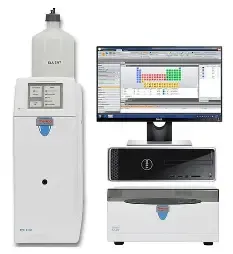
    Ion chromatography (IC) is a specialized form of high-performance liquid chromatography (HPLC) designed for the separation and detection of ionic species in solution, including inorganic and organic anions, cations, and polar molecules. Its main advantages include efficient ion separation, high-sensitivity detection, simultaneous multi-component analysis, automation, and high throughput. IC operates based on the principle of ion exchange, utilizing the interactions between the stationary phase (ion-exchange resin) and the mobile phase to achieve efficient separation of different ions. Additionally, it can distinguish between different oxidation states of the same element.
    Advantages:

    • Rapid and convenient
    • High sensitivity
    • Good selectivity
    • Capable of simultaneous analysis of multiple ionic compounds
    • Good stability and high capacity of the separation column
    Principle

    Principle

    Principle

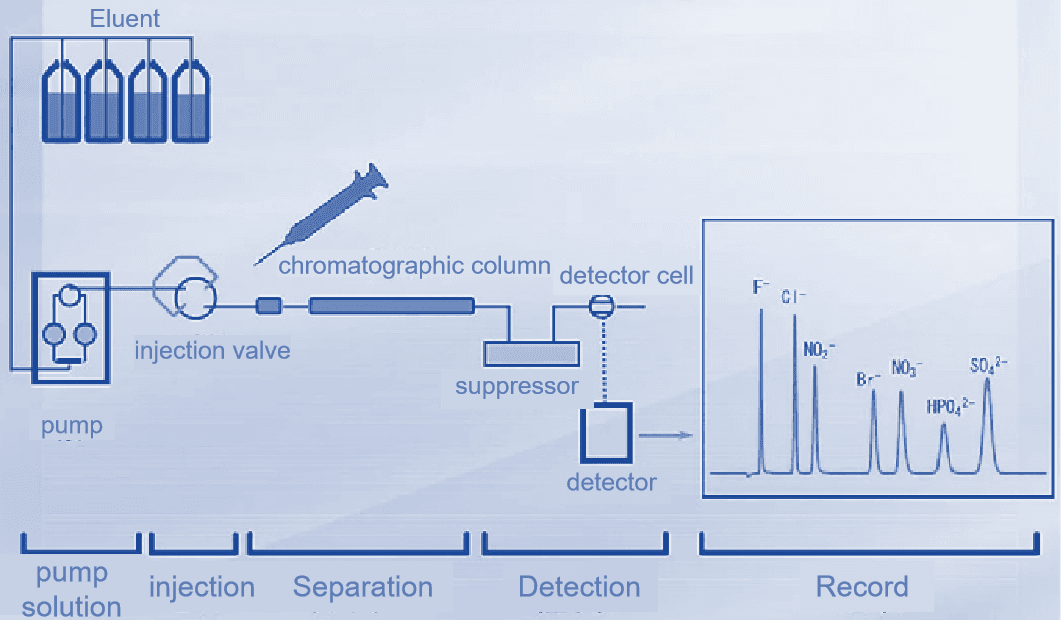
    • The basic components of an ion chromatography system include:

      Chromatographic column: Typically composed of ion-exchange resins or other specialized materials used for separating different ionic compounds.

      Sample solution: The sample to be analyzed is usually dissolved in water or another solvent.

      Detector: Used to detect the presence and concentration of ionic compounds.

    • The separation process in ion chromatography relies on the interaction characteristics of ions in the solution with the chromatographic packing material in the column. These interactions include ion exchange, affinity adsorption, exclusion effects, and more. By adjusting the column packing and operating conditions such as flow rate, temperature, and gradients, selective separation of different ions can be achieved.

    • Organic compounds can clog the chromatographic column.

    • The pretreatment methods are relatively complex; for specific procedures, please consult an engineer.

    • The conductivity of the sample should ideally be below 300 μS/cm.
    • If it is too high, dilution is required before testing, which may introduce some errors.

    • C₁₈ column: Used to remove hydrophobic compounds; not suitable for samples with excessively high or low pH.
    • RP column: Removes hydrophobic compounds, especially unsaturated and aromatic compounds; suitable for pH range 0–14.0.
    • H column: Removes alkaline earth metals, transition metal ions, and carbonate ions from the sample matrix; also used to neutralize strongly alkaline sample solutions.
    • Na column: Removes alkaline earth metals and transition metal ions from the sample matrix.
    • Ag column: Removes Cl⁻, Br⁻, I⁻, AsO₄³⁻, CrO₄²⁻, CN⁻, MoO₄²⁻, PO₄³⁻, SeO₃²⁻, SO₃²⁻, SeCN⁻, S²⁻, SCN⁻, WO₄²⁻, and other ions.
    • Ba column: Removes SO₄²⁻; when the anion concentration in the sample is low, the column needs to be activated with a Cl⁻ solution.
    application

    application

    In the detection of inorganic ions:

    • Drinking water quality analysis, food safety testing for products like beer and beverages
    • Compliance monitoring of wastewater discharge, quality control of industrial products including metallurgical process water
    • Petroleum industry samples, as well as the analysis of residual halide ions in the electronics industry.

    In the detection of organic ions:

    • The analysis of biogenic amines (such as putrescine, histamine, and cadaverine) has become an important tool in forensic science and criminal investigations.
    • The detection of organic acids—including lactic acid, formic acid, acetic acid, propionic acid, butyric acid, isobutyric acid, valeric acid, isovaleric acid, malic acid, and citric acid—provides a simple and effective separation method in both microbial fermentation and the food industry.
    • For carbohydrate analysis, various methods have been developed for the determination of sugars such as glucose, lactose, xylose, arabinose, and sucrose, with particularly broad applications in the food industry.

    Determination of lithium salt species in lithium battery electrolytes by ion chromatography.

    Determination of lithium salt species in lithium battery electrolytes by ion chromatography.

    • Determination of lithium salt species in lithium battery electrolytes by ion chromatography.
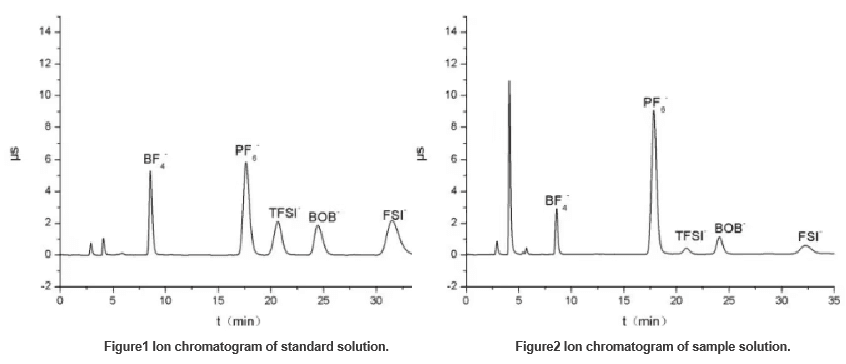
    • A method was developed for the detection and quantification of five lithium salts in lithium battery electrolytes using ion chromatography with conductivity detection. After dilution and filtration through a 0.22 μm nylon membrane, a 25 μL sample was injected and separated using IonPac AG22 (4×50 mm) and IonPac AS22 (4×250 mm) columns at a column temperature of 35 °C. Isocratic elution was performed with a carbonate–acetonitrile mixture (70:30, v/v) as the eluent at a flow rate of 1.0 mL/min.
    • Under optimized conditions, the five target ions were well separated, showing good linearity (r > 0.9996). The relative standard deviations of retention time and peak area were less than 0.64% and 0.94%, respectively (n = 7). The limits of detection ranged from 0.068 to 0.29 mg/L (S/N = 3). The recoveries for spiked samples ranged from 91.49% to 108.99%.
    • This method is suitable for the determination of lithium salt species in lithium battery electrolytes, offering advantages such as simple operation, high sensitivity, and good reproducibility.

    1. Aqueous solution

    • The sample should be a simple aqueous solution of ions.
    • If the composition is too complex, overlapping ion peaks may occur, making it impossible to accurately quantify the ion concentrations.

    2. Testable ion species include: Br⁻, F⁻, Cl⁻, SO₄²⁻, NO₃⁻, NO₂⁻, PO₄³⁻, formate, acetate, propionate, butyrate, valerate, NH₄⁺, Li⁺, Na⁺, K⁺, Mg²⁺, and Ca²⁺.

    • CO₃²⁻, and HCO₃⁻ are measured using titration, and the sample volume should be greater than 50 mL.
    • For other ions, 10–15 mL of sample is sufficient for testing.
    • It is recommended that the concentration of the ions to be measured is within the ppm range.
    • Please indicate the concentration range when making an appointment.

    3. For special samples or specific ion content testing requirements, please consult your account manager.

  • Ion chromatography is commonly used for the analysis of ions in water samples, including cations (e.g., sodium, potassium, ammonium ions) and anions (e.g., chloride ions, nitrate ions, sulfate ions).

  • Ion chromatography (IC) is a chemical analysis technique used for the separation and analysis of ionic compounds in solution. It is an efficient and highly sensitive analytical method widely applied in environmental monitoring, food analysis, biochemistry, pharmaceuticals, and other fields.