
info@universallab.org
WhatsApp: +41762172997
Sample Requirements
Application Case
Example Result
What our customers are saying
Need precise analysis? Contact us – we'll help you choose the best solution for your needs.

Price may vary based on selected options
Delivery time: 1 ~ 2 weeks
XRF (X-ray Fluorescence Spectrometry) is a non-destructive analytical technique used to determine the elemental composition of materials. It is widely appreciated for its speed, simplicity, and ability to analyze solids, liquids, and powders with minimal sample preparation.

XRF (X-ray Fluorescence Spectrometry) is a non-destructive technique for identifying and quantifying elemental composition.
It is widely used across industries for its speed, versatility, and minimal sample preparation.
XRF plays a critical role in quality control, material verification, environmental testing, and regulatory compliance.

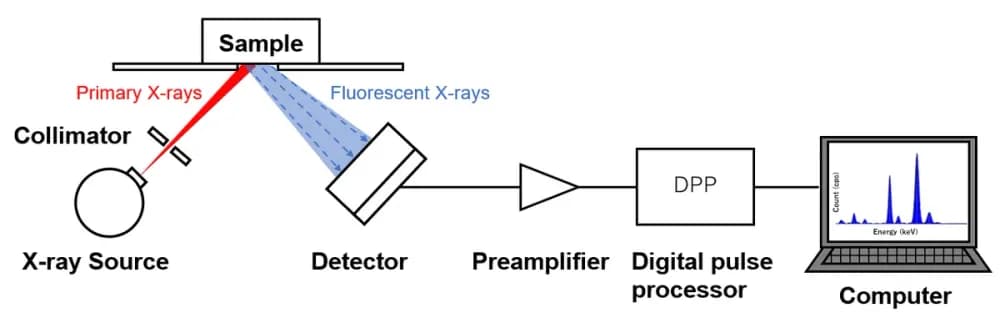
XRF works by irradiating a sample with primary X-rays, which excite the atoms in the material, causing them to emit secondary (fluorescent) X-rays. The energy and intensity of these emitted X-rays are characteristic of the elements present and their concentrations.

XRF instruments are generally categorized into two main types: EDXRF (Energy Dispersive X-ray Fluorescence) and WDXRF (Wavelength Dispersive X-ray Fluorescence). While both techniques are based on the same principle of X-ray-induced fluorescence, they differ significantly in detection method, performance, and application suitability.
EDXRF uses a solid-state detector to measure the energy of fluorescent X-rays directly. It is typically faster, more compact, and well-suited for general-purpose analysis, including fieldwork and quick screening of materials. However, its spectral resolution and accuracy—especially for light elements—are more limited.
WDXRF, in contrast, disperses the emitted X-rays through crystals to measure their wavelength with high precision. This results in better spectral resolution, lower detection limits, and greater quantitative accuracy, particularly for light and trace elements. WDXRF systems are generally larger, more expensive, and used in applications demanding high analytical performance such as in the cement, metallurgy, and petrochemical industries.
When to choose:
Use EDXRF for general screening, handheld/portable analysis, or when budget and speed matter more than ultra-precision.
Choose WDXRF when you need high-resolution, trace-level accuracy, or are dealing with complex matrices (e.g., in cement, steel, petrochemical industries).
Comparison of Elemental Analysis Methods (Method as Columns)
| Attribute | XRF | ICP-OES | ICP-MS | AAS (Flame/Furnace) | Wet Chemistry (Titration) |
|---|---|---|---|---|---|
| Working Principle | X-ray induced fluorescence | Optical emission from excited atoms in plasma | Mass detection of ions in plasma | Light absorption by ground-state atoms | Stoichiometric chemical reactions |
| Elements Detected | ~40 (Na to U) | ≥70 (metals and non-metals) | ≥75 | Limited (~30) | Limited |
| Detection Limits | ppm | sub-ppb to ppm | ppt to ppb | ppm to ppb (graphite furnace) | Variable |
| Sample Throughput | High | High (multi-element) | High | Low (single element) | Low |
| Matrix Tolerance | Variable | Good (with interference correction) | High (with collision or reaction cells) | Moderate | Low |
| Recommended Use | Solid sample screening, bulk composition | Routine trace analysis in complex matrices | Ultra-trace and speciation studies | Low-cost single-element analysis | Classical wet-lab environments |
Note: For precise quantification or elements like C, N, O, consider complementary techniques such as CHNS elemental analyzers or ICP-OES.
XRF is a rapid, reliable, and cost-effective elemental analysis tool, ideal for solid and bulk material analysis across industries. Its minimal sample preparation and non-destructive nature make it an excellent choice for routine quality control and material verification.
No, XRF is not sensitive to elements lighter than sodium (Na). For light element analysis, other techniques such as combustion analysis or CHN analyzers are needed.
Not always. Bulk solids and smooth surfaces can often be measured directly. Powders and liquids may require pressing or containment.
Yes. Handheld XRF analyzers are widely used for on-site material screening and elemental analysis.
ICP methods generally offer higher accuracy and lower detection limits, but require more complex sample preparation.
Most XRF tests take between 30 seconds and 3 minutes per sample.

XRF instruments are generally categorized into two main types: EDXRF (Energy Dispersive X-ray Fluorescence) and WDXRF (Wavelength Dispersive X-ray Fluorescence). While both techniques are based on the same principle of X-ray-induced fluorescence, they differ significantly in detection method, performance, and application suitability.
EDXRF uses a solid-state detector to measure the energy of fluorescent X-rays directly. It is typically faster, more compact, and well-suited for general-purpose analysis, including fieldwork and quick screening of materials. However, its spectral resolution and accuracy—especially for light elements—are more limited.
WDXRF, in contrast, disperses the emitted X-rays through crystals to measure their wavelength with high precision. This results in better spectral resolution, lower detection limits, and greater quantitative accuracy, particularly for light and trace elements. WDXRF systems are generally larger, more expensive, and used in applications demanding high analytical performance such as in the cement, metallurgy, and petrochemical industries.
In summary, EDXRF is preferred for speed and flexibility, while WDXRF is ideal for high-precision quantitative analysis where detection limits and elemental resolution are critical.
When to choose:
Example XRF results table
| Element | Concentration (%) | Detection Limit (%) |
|---|---|---|
| Fe | 0.745 | 0.005 |
| Zn | 0.092 | 0.003 |
| Pb | 0.014 | 0.001 |
| Ti | 0.112 | 0.004 |
| Ca | 5.235 | 0.010 |
Comparison of Elemental Analysis Methods (Method as Columns)
| Attribute | XRF | ICP-OES | ICP-MS | AAS (Flame/Furnace) | Wet Chemistry (Titration) |
|---|---|---|---|---|---|
| Working Principle | X-ray induced fluorescence | Optical emission from excited atoms in plasma | Mass detection of ions in plasma | Light absorption by ground-state atoms | Stoichiometric chemical reactions |
| Elements Detected | ~40 (Na to U) | ≥70 (metals and non-metals) | ≥75 | Limited (~30) | Limited |
| Detection Limits | ppm | sub-ppb to ppm | ppt to ppb | ppm to ppb (graphite furnace) | Variable |
| Sample Throughput | High | High (multi-element) | High | Low (single element) | Low |
| Matrix Tolerance | Variable | Good (with interference correction) | High (with collision/reaction cells) | Moderate | Low |
| Recommended Use | Solid sample screening, bulk composition | Routine trace analysis in complex matrices | Ultra-trace and speciation studies | Low-cost single-element analysis | Classical wet-lab environments |
Advantages:
Limitations:
Accurate and reliable XRF analysis requires attention to sample presentation. While XRF is known for its minimal preparation requirements, optimizing certain parameters can significantly enhance measurement quality and reproducibility.
| Sample Type | Acceptable? | Notes |
|---|---|---|
| Bulk solids | ✔ | Best results with flat, homogeneous surfaces |
| Powders | ✔ | Pressed into pellets or analyzed in sample cups |
| Liquids | ✔ | Analyzed in film-covered liquid sample cells |
| Films/Coatings | ✔ | Require smooth substrate and known layer structure |
| Irregular solids | ⚠ | Possible with calibration corrections; affects reproducibility |
| Gels/Suspensions | ⚠ | Should be dried or stabilized before measurement |
Minimum Amount:
Thickness:
Shape:
| Sample Type | Preparation Recommendations |
|---|---|
| Bulk Solids | Wipe clean; polish if necessary for coatings/thin films |
| Powders | Grind to uniform particle size (≤75 µm), dry if needed, press into stable pellets with binder |
| Liquids | Pour into clean XRF cups sealed with Mylar or Prolene film; avoid air bubbles |
| Films | Mount on flat substrate with known thickness and composition |