
info@universallab.org
WhatsApp: +41762172997
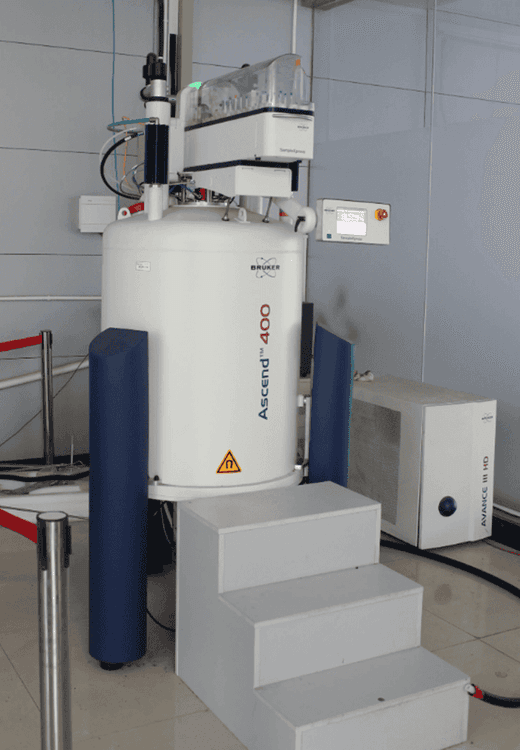
Liquid Nuclear Magnetic Resonance NMR Measurement (liquid)
Variant (SKU)
Default
Price may vary based on selected options
Delivery time: 1 ~ 2 weeks
Liquid-state Nuclear Magnetic Resonance (NMR) is a physical phenomenon based on the interaction between nuclear spins and magnetic fields, and is used to study molecular structure, chemical composition, dynamics, and intermolecular interactions. Liquid-state NMR is mainly applied to the analysis of solution samples. With its high resolution and quantitative analysis capabilities, it is an important tool in modern chemistry, biology, and materials science.
Introduction
Introduction
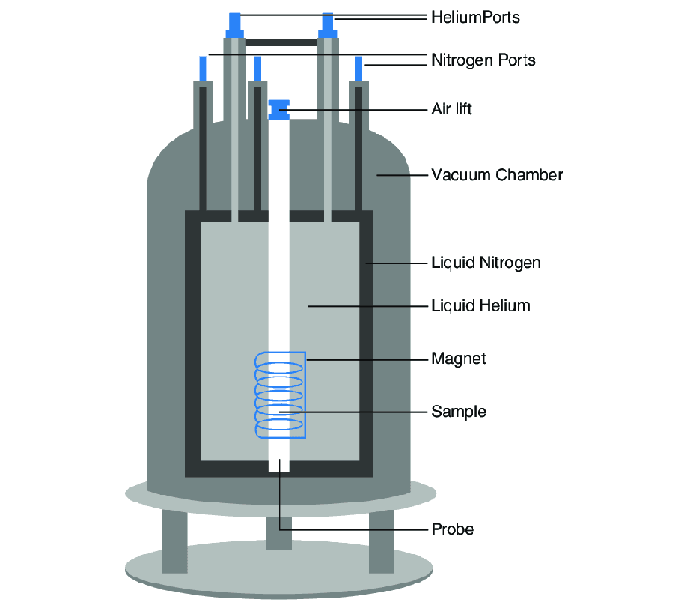
Liquid nuclear magnetic resonance (NMR) is an analytical technique based on the physical phenomenon that nuclear spins absorb radiofrequency energy in an external magnetic field. It is commonly used to detect the chemical environment of elements with nuclear spin (such as ¹H, ¹³C, ³¹P, etc.) in molecules. NMR can provide rich information about molecular structure, dynamics, and interactions.
Advantages:
- High resolution
- Non-destructive
- High quantitative power
Scope
- Identification of Organic Molecular Structures
- Analysis of Ligand-Metal Complexation
- Reaction Process Monitoring
- Impurity Analysis and Purity Testing
Principle
Principle
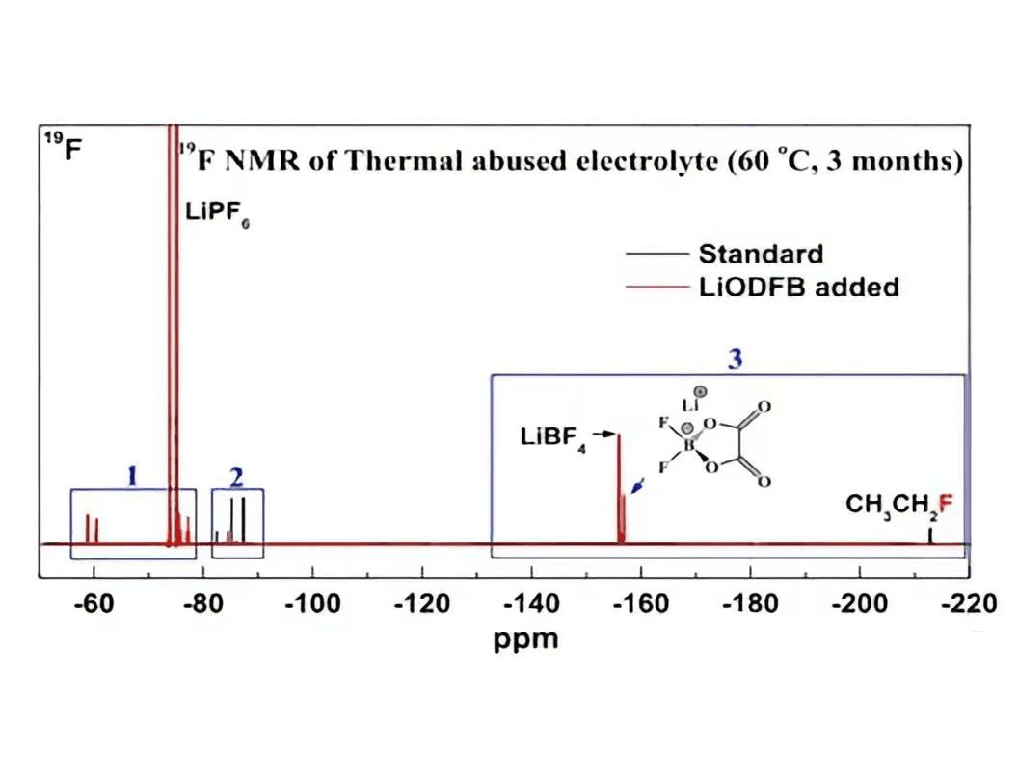
NMR is a method of studying the chemical environment in a sample using the resonance phenomenon of atomic nuclei in an applied magnetic field. The principle is based on the absorption and emission of radiofrequency radiation by nuclear spins in an external magnetic field. Each NMR spectrum contains the following key information:
- Chemical shift (δ\deltaδ, ppm): The chemical shift is determined by the chemical environment of the nucleus in the molecule.
- Peak area: The area of the peak is proportional to the number of atoms in that chemical environment.
- Multiple peak splitting (coupling constant, J-value): Spin-spin coupling of neighbouring nuclei leads to signal splitting (e.g. single, double, triple, etc.).
- Peak width (half peak width): Correlates with molecular motion and sample purity. Wide peaks may indicate chemical exchange or larger molecular size.
Test procedure
- Sample Preparation: The sample to be tested is dissolved in an appropriate deuterated solvent (such as CDCl₃, DMSO-d₆, CD₃OD, etc.), usually at a concentration of several mg/mL. The solution should be filtered to remove insoluble matter and loaded into a special NMR tube (generally 5 mm in diameter).
- Instrument Setup: The sample tube is inserted into the magnet of the NMR instrument, the temperature is adjusted (room temperature or a specific temperature), the appropriate nucleus (¹H, ¹³C, etc.) is selected, and scanning parameters (such as number of scans, delay time, pulse width, etc.) are set.
- Data Acquisition: The instrument emits radiofrequency pulses to excite the nuclear spin system in the sample. After absorbing energy, the nuclear spins transition to an excited state and then release energy as they return to the ground state, generating a free induction decay (FID) signal, which is detected by the instrument.
- Data Processing: The FID signal is converted into an NMR spectrum by Fourier transform. The spectrum is then processed with phase correction, baseline correction, integration, and chemical shift calibration.
Sample Requirements
Sample
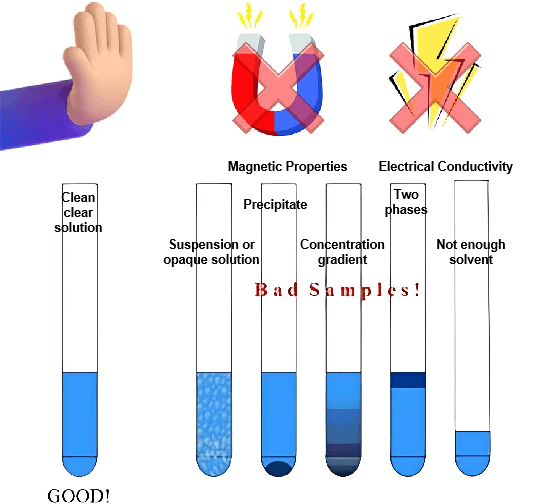
(1) fundamental requirement: The sample needs to be non-magnetic, non-conductive, and should be pure, dry.
(2) Sample amount:
- The recommended dosage for 1H spectrum is 5-10 mg, and the concentration should not be too low or too high, so as not to affect the homogeneous effect.
- For 13C spectrum and heteronuclear spectrum, the recommended dosage is 20-100 mg. The higher the concentration, the faster the peak will appear, which can save the testing time.
- For polymers and other high molecular weight compounds, it is recommended to increase the sample volume appropriately.
- For 2D experiments, sufficient sample concentration is required to obtain a good signal-to-noise ratio. 25 mg of sample is sufficient to complete all experiments (including HMBC experiments with hydrogen-carbon correlation).
(3) Solvent Selection: The solvent should have good solubility and its signal should not overlap with the sample signal, the smaller the viscosity the better.
(4) Internal standard: Chemically inert substances that do not associate with the sample and whose peaks are located in the high field (generally organic substances peak on the left side) should be selected.
(5) liquid samples: For liquid samples, please indicate whether it is pure or solution and specify the solvent used.Please use centrifuge tubes for samples.
(6) Special instructions: If you need to use deuterated chloroform as a solvent, please do not dissolve it yourself and send the sample.
Application Case

application
(1) Chemistry
- Molecular Structure Elucidation: ¹H and ¹³C NMR spectroscopy are widely used for the rapid determination of molecular chemical structures.
- Dynamic Reaction Studies: In situ NMR enables real-time monitoring of chemical reactions, such as observing intermediates and kinetics in catalytic processes.
(2) Biology and Pharmaceutical Sciences
- Protein Structure Analysis: Two-dimensional NMR techniques (e.g., HSQC, NOESY) are employed to resolve the tertiary structures of proteins in solution.
- Metabolomics: Liquid-state NMR is used to analyze metabolites in biological samples (such as urine and serum), providing insights into disease-related metabolic mechanisms.
(3) Drug Discovery
- Drug Screening: NMR can be used to analyze the binding affinity between small-molecule drugs and target proteins.
(4) Materials and Polymer Science
- Polymer Sequence and Molecular Weight Distribution: NMR techniques are applied to determine the chemical structure and molecular weight distribution of polymers.
- Nanomaterial Characterization: Diffusion NMR can measure the diffusion behavior of functionalized nanoparticles in solution, aiding in the study of surface modification effects.
(5) Environmental and Food Science
- Environmental Pollutant Detection: NMR is used to analyze organic pollutants (such as phenols and aromatic amines) in water.
- Food Quality Control: Liquid-state NMR can be used to analyze food components, such as fatty acids and carbohydrates.
Example Result
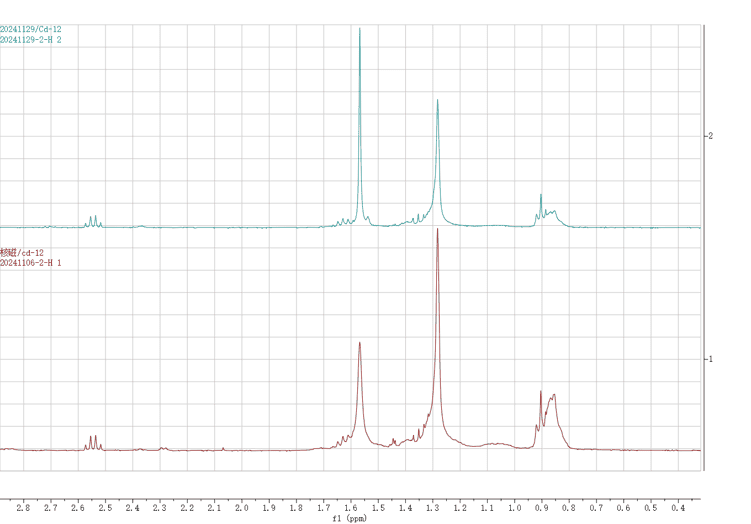
Result
- The ¹H NMR spectrum of cadmium dodecanethiolate (Cd(DDT)₂) exhibits the characteristic features of its molecular structure. The main peaks are distributed between 0.4 ppm and 2.8 ppm.
- The small peaks at 0.8–1.0 ppm correspond to the terminal methyl (-CH₃) protons, while the strong peaks at 1.2–1.4 ppm are attributed to the methylene (-CH₂-) protons along the alkyl chain. The peaks at 2.5–2.7 ppm are assigned to the methylene protons adjacent to the sulfur atom (-CH₂-S-). Integration analysis of these peaks shows that the number of protons matches perfectly with the theoretical structure of cadmium dodecanethiolate, indicating that the sample has the correct structure and high purity.
- The results of this NMR spectrum confirm that the synthesized product is indeed the target compound, with no significant impurities or byproducts detected. The agreement between the integrated proton numbers and the expected values further verifies the sample’s composition. This analytical approach is of great significance in the fields of organometallic complexes and nanomaterials.
Conclusions
- Liquid-state NMR can be used for qualitative analysis of the composition and structure of various organic and inorganic substances, as well as for quantitative analysis. In addition to its application in medical imaging, it is most widely used in analytical chemistry, structural studies of organic molecules, and material characterization.
What our customers are saying
Need precise analysis? Contact us – we'll help you choose the best solution for your needs.

Frequently Asked Questions
- Select the suitable solvent by the nature of the sample and the synthesis conditions.
- Find the literature dissolution mode and conditions.
- After selecting the solvent, in order to ensure the solubility of the sample to get good test results, it is recommended to use ordinary non-deuterated reagents first.
- It is recommended to dissolve the sample with ordinary non-deuterated reagent first to judge the solubility performance of the sample and select the suitable solvent.
- One-dimensional spectrum is what we often call the hydrogen spectrum, carbon spectrum, fluorine spectrum and so on.
- Two-dimensional spectrum is related spectrum, we often say COSY, HSQC, HMBC, NOESY, etc. are two-dimensional spectra.
- the concentration is too small;
- the accumulation time is too short and needs to be increased;
- the phase is not tuned properly and needs to be tuned.
- The sample amount is too small.
- The sample has poor solubility; even if a large amount of sample is provided, the actual dissolved amount may be quite low.
- Magnetic and conductive properties can also affect the signal. Liquid NMR testing requires the sample to form a homogeneous solution. If the sample is dispersed rather than truly dissolved, the resulting spectrum is likely to be of poor quality.
- The main purpose of hydrogen-deuterium exchange experiment is to prove the existence of active hydrogen, in order to measure the resonance peaks of these active hydrogens on the NMR spectrometer, it is necessary to choose organic solvents that do not have active hydrogen, active gas, such as deuterium DMSO.
- The common procedure of hydrogen exchange experiment is: choose the appropriate deuterium reagent that does not contain active hydrogen, if the deuterium DMSO dissolves the sample, test a conventional hydrogen spectrum, after the test is complete, then add a drop of heavy water to the head of the NMR tube, if the sample contains active hydrogen signal will disappear. After the test is completed, 1-2 drops of heavy water are added to the head of the NMR tube. If the sample contains active hydrogen, the signal of active hydrogen will disappear, so as to judge the existence of active hydrogen.