
info@universallab.org
WhatsApp: +41762172997
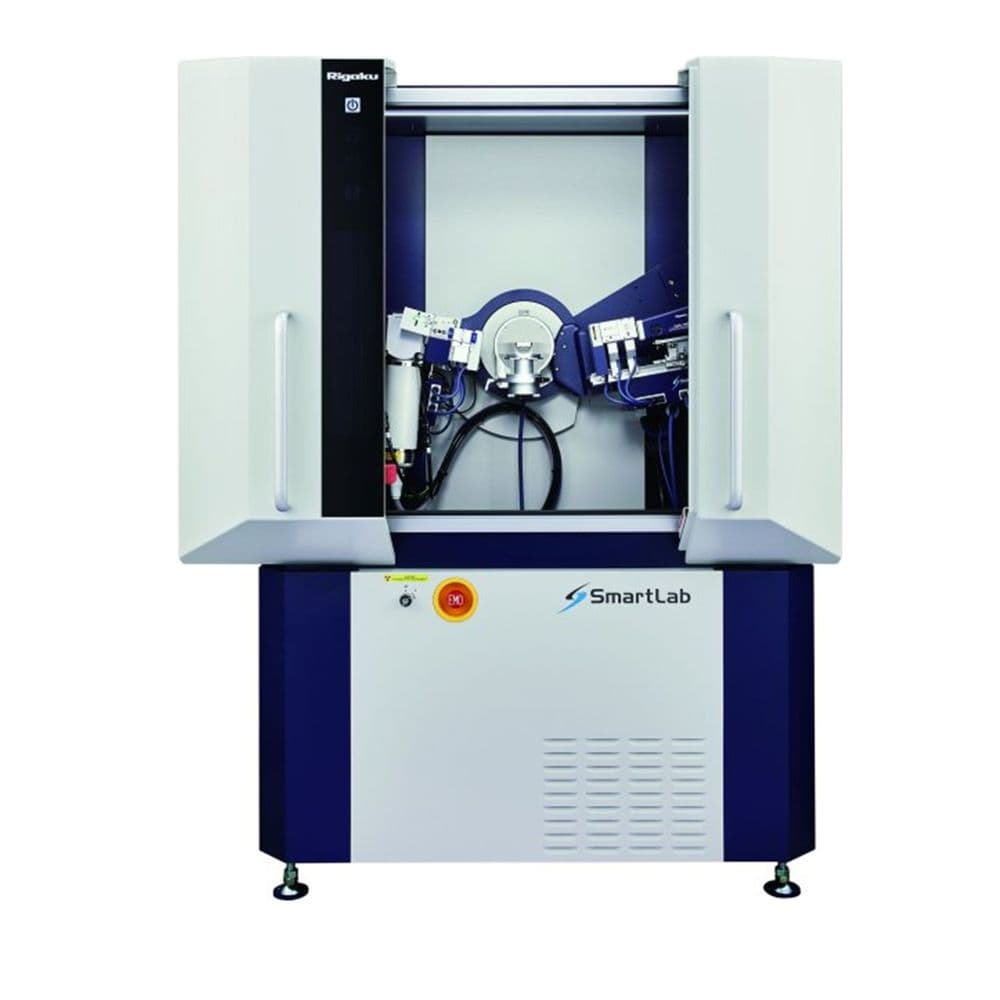
Price may vary based on selected options
Delivery time: 1 ~ 2 weeks

Reciprocal Space Mapping (RSM) is a powerful, high-resolution X-ray diffraction (XRD) technique used primarily to investigate the crystal structure perfection, strain, and defects within thin films, multilayers, epitaxial structures, and bulk single crystals. Unlike conventional XRD scans (like ω-2θ or rocking curves) which provide information along a single line in reciprocal space, RSM builds a detailed two-dimensional (2D) intensity map representing a specific plane or region within the crystal's reciprocal lattice. Key Advantages:

Reciprocal Space Foundation:
Yes, if dislocation density is more than 10⁸ cm⁻² (appears as diffuse scattering between film or substrate peaks).
Method: Fit ω-scan of RSM cross-section at fixed Qz , FWHM = mosaic spread (arcmin/deg).


Reciprocal space maps near Bragg maxima (004) and (224) measured and simulated in order to determine the shape of the (Ga,Mn)As micro-wires on GaAs substrate. The most intensive point is the substrate peak of unstrained GaAs, the intensity distributed around this peak is related to the strained parts of the substrate in the vicinity of the wires. The intensity from partially relaxed (Ga,Mn)As wires is concentrated in the intense streak bellow the substrate peak, the fringes in between are the thickness oscillations from the wires.

Measured (left) and simulated (right) diffraction map from oxidized Si-wires for Ge nanoheteroepitaxy. The intensity is present only along the truncation rods as a consequence of the lateral periodicity of the wires. The lateral period is very small in this case, therefore the distance of the truncation rods in the reciprocal space is large enough to see the individual satellites.
-Thickness 3 mm
Reciprocal space mapping is a high-resolution X-ray diffraction method to measure a reciprocal space map (RSM). These maps around reciprocal lattice spots can reveal additional information beyond that provided by single line scans, such as high-resolution rocking curves. RSMs are typically used to aid the interpretation of peak displacement, peak broadening, or peak overlap.