
info@universallab.org
WhatsApp: +41762172997
Price may vary based on selected options
Delivery time: 1 ~ 2 weeks

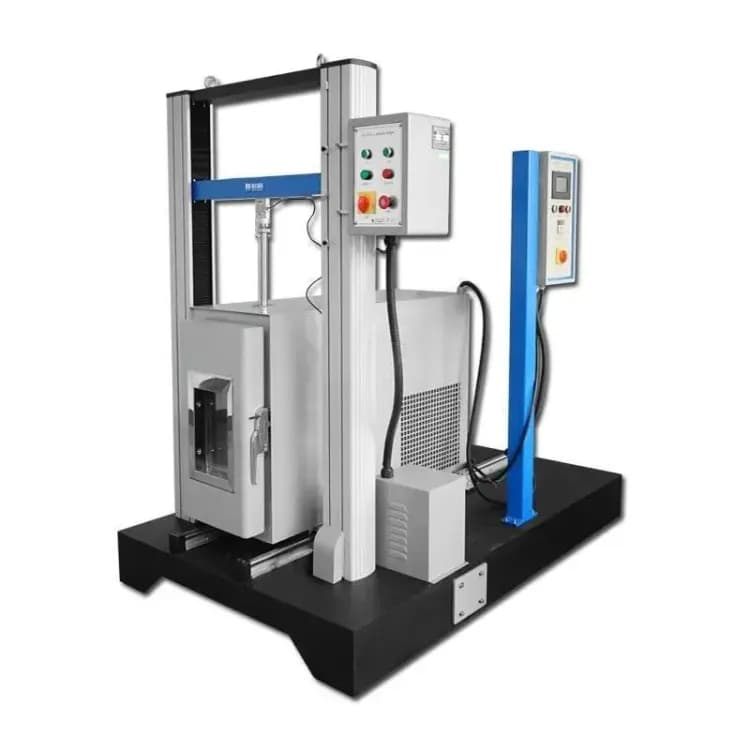
Tensile testing at low temperature is a method used to measure how materials behave when they are stretched under cold conditions. Many engineering materials, such as metals and polymers, can become more brittle or lose strength at low temperatures. This type of test helps engineers understand whether a material can maintain its strength, flexibility, and reliability in cold environments, such as in aerospace, cryogenics, or polar regions. By simulating these conditions in the lab, tensile testing at low temperatures provides critical data for safe material selection and design in extreme environments.

The low-temperature tensile test is a specialized method used to evaluate the mechanical properties of materials—such as strength, ductility, and fracture behavior—under cryogenic conditions. This is critical for applications in aerospace, energy, and other industries where materials must perform reliably at extremely low temperatures.
Test Setup and Process:
Typically down to -196°C (liquid nitrogen). Lower temperatures (e.g., with liquid helium) may be possible with specialized equipment.
Usually 10–30 minutes, depending on sample size and target temperature, to ensure uniform temperature throughout the specimen.
Yes, tests comply with standards such as: ASTM E8, E21, E1450 ISO 6892-2 (Tensile testing of metals at low temperatures)


Specimens should be machined to standard shapes and dimensions (such as dog-bone or round bar) according to relevant standards like ASTM E8/E21 or ISO 6892-2, ensuring comparability and reliability of results.
The surface of the specimen must be smooth, free from scratches, cracks, or other mechanical damage to avoid stress concentration effects.
Material uniformity is important; specimens should be taken from the same batch and orientation, with no internal defects or inclusions.
Dimensional accuracy is essential, as precise measurements of diameter, length, and gauge length are needed for accurate stress calculations, especially at low temperatures.
Specimens may require specific pre-treatment, such as heat treatment or stress relief, to ensure representative microstructure and eliminate residual stresses.
Before testing, specimens should be thoroughly cleaned and dried to prevent contamination, frost, or slippage during gripping at low temperatures.
Gauge length should be clearly marked on the specimen for accurate elongation and fracture measurements.
Tensile test at low temperature is used to evaluate how materials behave when stretched under extremely cold conditions. It helps determine a material’s strength, ductility, and fracture performance in cryogenic environments.